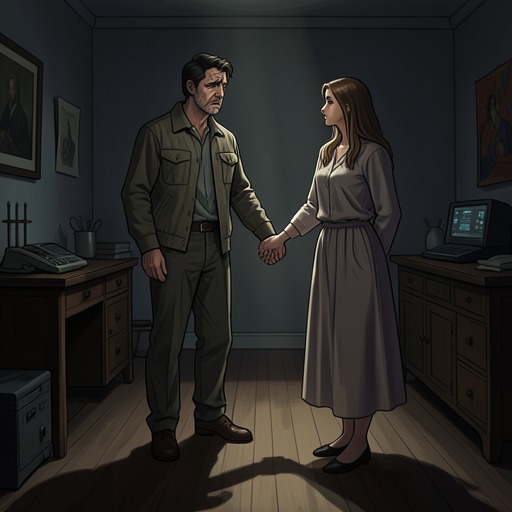
Jake’s Secret Entry into the BCSC Expedition
Happiness for BeginnersJake’s Secret Entry into the BCSC Expedition is the choice by Jake to conceal an incurable inherited vision disorder and get onto the trip despite failing its medical screening. What begins as a private workaround becomes a disclosure of the stakes behind his participation: he knows his sight will deteriorate, has abandoned the future his father expected for him, and is determined to take part in life while he still can.
Diagnosis and the decision to go
Jake’s entry is not a straightforward continuation of his original plans. He later tells Helen that he signed up, canceled, and signed up again. He canceled because he was having trouble with his eyes; after several examinations and tests, he learned that he had an inherited vision disorder that could not be fixed. Night blindness was already one part of it. The reversal from cancellation to renewed registration makes the expedition a decision made in full knowledge of the condition, not an attempt to discover whether anything is wrong.
That knowledge remains largely hidden during the trip. After Jake falls out of a tree, Helen asks whether darkness or his night blindness caused him to miss a branch. Jake says he merely slipped, then asks her not to mention the night blindness to anyone. He initially frames his request through their status as strangers: as strangers, she could not possibly know. The explanation offers a cover, but it does not hold. He adds that he did not pass the medical examination.
Falsified clearance and concealed whereabouts
Jake explains that a friend in medical school falsified his report. When Helen asks why he would do that, his answer is simple: so he could come on the trip. The evasion is specific and consequential. He has not merely kept a diagnosis to himself; he has circumvented the medical screening that should have prevented his participation. The evidence establishes that he conceals his condition and secures entry by fraudulent paperwork, though it does not specify what formal consequences follow.
His secrecy extends to his father. His father knows about the vision disorder and had not wanted Jake to come, but does not know that Jake is on the expedition at all. Jake tells him he is attending a Buddhist meditation retreat in the Berkshires. The false destination protects the trip from his father’s opposition, while the fabricated medical report protects his participation from the screening process. Together, the lies make his presence possible and keep the people most likely to stop him from intervening.
The family pressure behind that concealment is tied to Jake’s sense of how his father sees him. His father calls him Doc and, Jake says, sees the person he has always intended him to become. Jake describes his father as willing to have only one kind of son: high-achieving, hard-working, and a valedictorian. That ideal helps explain why the diagnosis is not only a medical crisis but a rupture in an expected identity. Jake has given up medical school, and he does not expect his father to adjust easily to the change.
Living with a future that is closing
By the time Jake explains the diagnosis more fully, he has spent the past year using his pre-med training to search through the information available to him. His conclusion is stark: there is nothing he can do except wait for the light to go out. The expedition takes place against that knowledge. Helen recognizes that he has carried it throughout their hikes while other people, including her, have complained about blisters and misunderstandings without appreciating what they still have.
Jake’s fear is not abstract. He imagines a future in which the work and ordinary independence he values will be altered by blindness. He has already lost the plan to become a doctor, and he worries about how he will manage daily tasks and keep his formidable intellect occupied. When he later describes the certainty of his diagnosis, he says that his future seemed to disappear: being a doctor, having several children, and learning to scuba dive had all belonged to the life he thought he would have. He recalls that the day he could no longer breathe or eat from the shock was the day before Helen appeared at a party with Pickle.
The trip sits within a larger effort to make use of what remains possible. Jake has a list of things he wants to see and do, mixing the exotic with the intimate: his childhood home, a merry-go-round in a park his grandmother took him to, and his father’s historic photographs of his great-grandparents and aunts and uncles in Texas. He also wants to scuba dive, drive a race car, and ride the world’s scariest roller coaster. These wishes do not reverse the diagnosis or restore the future he had planned. They show instead how much of his attention has turned toward specific experiences he can still pursue.
Disclosure and the meaning of his arrival
Jake’s concealment is eventually brought into the open in his conversation with Helen. He explains that he did not know for certain until shortly before Wyoming, after denial, bargaining, and many tests to establish how serious the condition was. Once he knew, he says, he could not breathe or eat, and he stopped thinking about asking Helen out. The disclosure places his secrecy alongside another retreat: he was already overwhelmed by the loss of his imagined future when Helen came back into his life.
Later, Jake tells her that within the next few years his eyes will go dark and that nothing can change this. He says he should leave her alone if he were a better person, but cannot, and identifies that as why he came: to be brave enough to tell her. His admission gives the earlier decision to join the expedition a second resonance. He had entered the trip by hiding what was happening to him; now he makes the condition, and his feelings, impossible to hide. The movement is not from illness to recovery, but from solitary concealment toward telling Helen the truth.